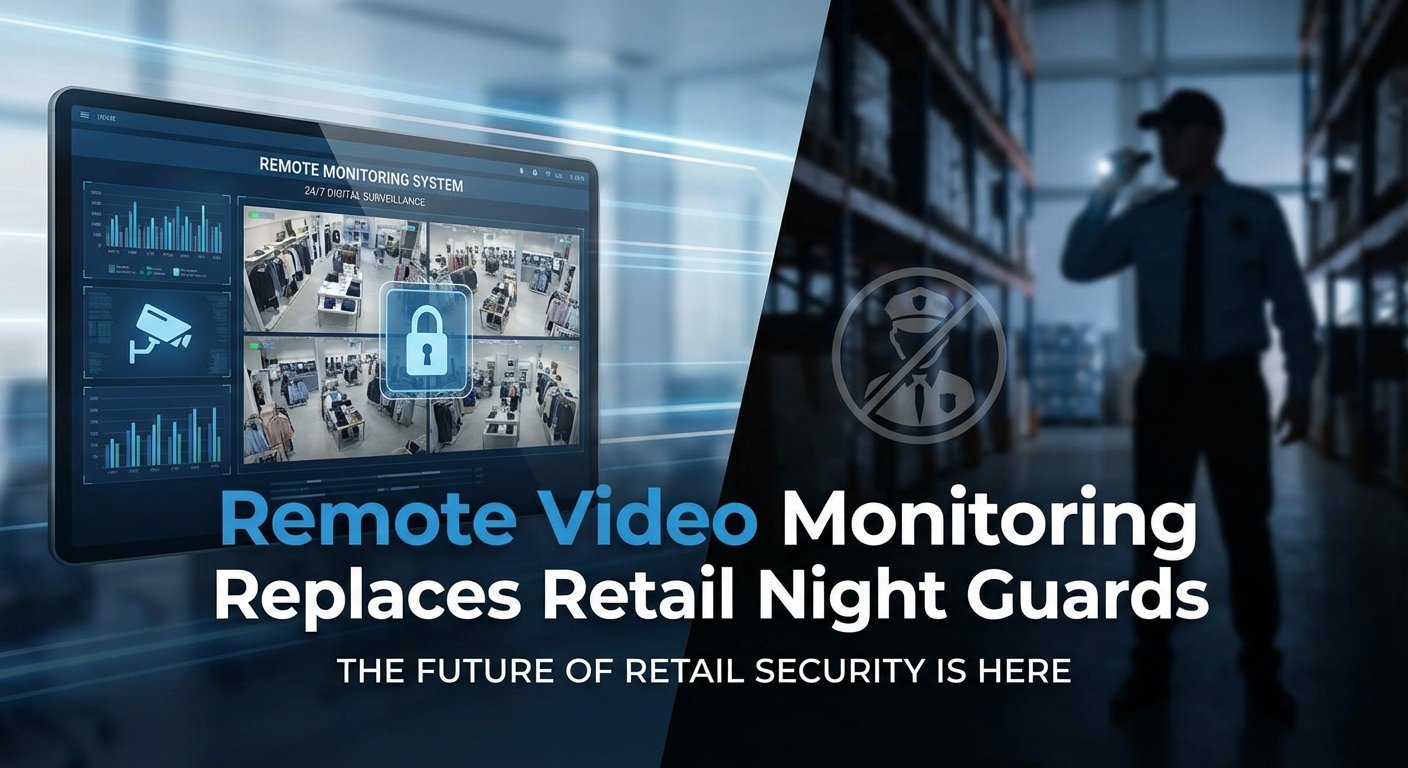
A major shift is transforming retail security operations in 2026. Store owners across the country are eliminating expensive night shift guard positions and replacing them with remote video monitoring systems staffed by trained security professionals watching from centralized command centers. The reason? Traditional on-site guards cost retailers between $60,000 to $100,000 annually per guard position when factoring in wages, benefits, insurance, and scheduling multiple shifts—while remote monitoring delivers superior coverage at roughly 40-60% of that cost.
This transition isn’t about cutting corners on security. Rather, it represents a strategic upgrade that addresses fundamental weaknesses in the traditional guard model while providing enhanced theft prevention, faster emergency response, and complete documentation of all security events.
The Critical Problems with Traditional Night Guards
Night shift security guards face unique challenges that compromise their effectiveness. A single guard can only monitor one location at a time, creating blind spots across multi-aisle retail environments. Human fatigue during overnight hours reduces alertness exactly when criminal activity peaks. The National Association for Shoplifting Prevention reports that external theft incidents increase by 73% during late-night and early morning hours when stores are closed or minimally staffed.
Beyond coverage limitations, retailers struggle with consistency issues. Guard quality varies significantly between individuals. Sick days, vacation coverage, and unexpected absences create gaps in protection. When incidents occur, documentation often depends on handwritten reports that lack the detailed visual evidence needed for prosecution or insurance claims.
Liability concerns add another layer of complexity. Guards confronting criminals risk physical altercations that endanger both the guard and expose retailers to workers’ compensation claims and potential lawsuits. These confrontations sometimes escalate situations that could be resolved through less risky interventions.
How Remote Video Monitoring Works for Retail Security
Remote video monitoring transforms retail security from reactive observation to proactive crime prevention. Strategically positioned high-resolution cameras with analytics capabilities monitor every critical area—entrances, sales floors, storage rooms, parking lots, and loading docks. These cameras connect to secure networks that transmit live footage to monitoring centers where trained security professionals watch multiple locations simultaneously.
Unlike traditional surveillance systems that simply record footage for later review, 24/7 video monitoring services provide real-time observation by virtual security guards who actively watch for suspicious activity. Advanced motion detection and AI-assisted analytics alert operators to unusual movement patterns, unauthorized access attempts, or behaviors that indicate criminal intent.
When operators detect suspicious activity, they immediately intervene through two-way audio systems, announcing their presence and instructing trespassers to leave the property. This vocal intervention stops the majority of incidents before any crime occurs. If criminals don’t comply, operators contact local law enforcement with real-time information about the situation, suspect descriptions, and exact locations—enabling faster, more effective police response.
Cost Analysis: Guards vs. Remote Monitoring
The financial comparison between traditional guards and commercial remote video monitoring reveals substantial savings. A single overnight security guard position costs retailers between $60,000 and $100,000 annually when including:
- Hourly wages ranging from $18-25 per hour for overnight shifts
- Overtime pay and shift differential premiums
- Health insurance, workers’ compensation, and payroll taxes
- Recruiting, training, and management overhead
- Coverage for sick days, vacation, and turnover replacement
Professional remote video monitoring typically costs between $400 and $1,200 monthly depending on property size, camera count, and monitoring hours—translating to $4,800 to $14,400 annually. Even at the higher end, retailers save between $45,000 and $80,000 per year compared to employing on-site guards.
For retail chains with multiple locations, these savings multiply exponentially. A regional chain with ten stores could save $450,000 to $800,000 annually by transitioning to business video monitoring services while simultaneously improving security coverage across all locations.
Superior Coverage and Response Capabilities
Remote monitoring provides comprehensive coverage that individual guards cannot match. Multiple cameras capture simultaneous views of all security zones, eliminating blind spots. Operators monitor numerous camera feeds concurrently, with intelligent analytics highlighting areas requiring attention.
This multi-perspective approach proves especially valuable during incidents. While a traditional guard at one end of a retail store might miss activity at the opposite end, remote operators view the entire property simultaneously, tracking suspects across multiple zones and identifying accomplices working in coordination.
Response speed improves dramatically. Traditional guards must assess situations, attempt intervention, and then contact authorities—a process consuming valuable minutes. Remote operators begin coordinating with law enforcement immediately while maintaining continuous visual contact with suspects, providing police with updated locations and descriptions as situations develop.
Retail Store Video Monitoring Applications
Different retail environments benefit from tailored monitoring approaches. Large format retailers like home improvement stores, furniture showrooms, and electronics retailers use retail store video monitoring to protect high-value inventory stored in warehouse-style environments where concealment opportunities abound.
Strip mall retailers and standalone stores particularly benefit from parking lot surveillance. Thieves often surveil stores from parking areas before attempting break-ins. Remote operators detect suspicious vehicles and individuals loitering near entrances during closed hours, intervening before criminals approach the building.
Automotive dealerships represent prime candidates for remote monitoring due to high-value inventory exposed in outdoor lots. Virtual security guards monitor vehicle inventory 24/7, instantly detecting unauthorized individuals accessing lot areas or attempting vehicle break-ins.
Convenience stores and gas stations, which experience disproportionately high robbery rates during overnight hours, use remote monitoring to deter criminal activity. The visible presence of monitored cameras combined with immediate audio intervention significantly reduces robbery attempts.
After-Hours Protection and Break-In Prevention
The vulnerability window between closing and opening shifts represents maximum exposure for retail theft and vandalism. Traditional alarm systems only notify authorities after criminals have already breached the property and begun causing damage or theft. By the time police arrive, perpetrators often escape with merchandise.
Commercial remote video monitoring detects suspicious activity before break-ins occur. Operators notice individuals testing doors, examining windows, or attempting to disable security equipment. Audio warnings inform potential criminals they’re being watched and police have been contacted—deterring the majority of attempts before any forced entry.
When break-ins do occur despite warnings, remote operators provide law enforcement with real-time suspect tracking, describing clothing, physical characteristics, vehicles, and escape directions. This detailed intelligence dramatically increases apprehension rates compared to reviewing recorded footage after incidents.
Documentation and Legal Protection
Recorded footage from monitored systems provides indisputable evidence for criminal prosecution and insurance claims. Unlike guard reports that present one person’s account of events, video documentation shows exactly what occurred, when, and how incidents unfolded.
This documentation proves invaluable for fraudulent liability claims. Slip-and-fall claims, allegations of excessive force, or disputes about property damage can be definitively resolved through video evidence, protecting retailers from frivolous lawsuits and false insurance claims.
Many insurance providers offer premium reductions for businesses utilizing professional 24/7 video monitoring services, recognizing the reduced risk profile these systems create. Some retailers recover their entire monitoring investment through insurance savings alone.
Employee Safety and Liability Reduction
Remote monitoring eliminates dangerous confrontations between guards and criminals. Traditional guards facing threats must decide whether to engage or retreat—both options carrying significant risks and liability exposure. Physical confrontations result in injuries, workers’ compensation claims, and potential litigation.
Virtual security guards intervene safely from remote locations without physical danger. Audio warnings and police coordination resolve situations without putting anyone at risk. This approach reduces workplace injuries, lowers insurance costs, and eliminates liability from physical security confrontations.
For stores maintaining minimal staff during opening/closing procedures, remote monitoring provides protective oversight. Operators watch employees arriving for opening shifts or completing closing procedures, ready to summon help if threatening situations develop. This protection extends to parking areas where employees are particularly vulnerable during dark early morning or late evening hours.
Integration with Existing Security Infrastructure
Modern business video monitoring services integrate seamlessly with existing access control systems, alarm systems, and point-of-sale equipment. This integration creates comprehensive security ecosystems where multiple systems work together rather than operating independently.
When alarm systems detect potential intrusions, remote operators immediately access corresponding camera views to verify threats and assess situations visually before dispatching authorities. This integration reduces false alarm police responses—a significant concern as many municipalities fine businesses for excessive false alarms.
Access control integration allows operators to verify that only authorized individuals enter restricted areas and receive alerts when doors are opened outside authorized times or by unauthorized credentials.
The Implementation Process
Transitioning from traditional guards to remote video monitoring involves straightforward steps. Professional security providers conduct site assessments identifying optimal camera placements for complete coverage of vulnerable areas. High-resolution cameras with night vision and weather-resistant housings are installed at strategic locations.
Network infrastructure connects cameras to monitoring centers through secure, encrypted connections protecting video feeds from unauthorized access. Redundant internet connections ensure continuous monitoring even if primary connections fail.
Monitoring center operators receive property-specific training including building layouts, access points, normal activity patterns, and emergency contacts. This knowledge enables them to distinguish between legitimate activity and genuine threats.
Most retailers transition gradually, initially implementing remote monitoring during overnight hours while maintaining some daytime guard presence. As confidence builds, many extend remote coverage to additional hours or eliminate guard positions entirely.
Choosing the Right Monitoring Partner
Not all remote monitoring services deliver equal value. When evaluating providers, retailers should verify that monitoring centers maintain 24/7 staffing with trained security professionals rather than automated-only systems. Human judgment remains essential for distinguishing actual threats from false positives.
Response protocols matter significantly. Quality providers maintain documented procedures for threat escalation, law enforcement coordination, and emergency notifications. Ask potential providers about average response times from threat detection to vocal intervention and police contact.
Experience with retail environments specifically helps providers understand typical activity patterns, common threat scenarios, and industry-specific security challenges. Providers familiar with retail security deliver more effective monitoring than generalized services.
Secure Your Retail Location with Professional Remote Monitoring
The retail security landscape has evolved beyond traditional guard services toward more effective, economical remote monitoring solutions. Retailers implementing professional video monitoring systems experience fewer theft incidents, lower security costs, reduced liability exposure, and enhanced employee safety while maintaining superior documentation of all security events.
Digital Security Guard specializes in retail store video monitoring, delivering comprehensive protection through experienced security professionals monitoring your property 24/7. Our virtual security guards provide proactive threat prevention, immediate intervention, and seamless law enforcement coordination—all at a fraction of traditional guard costs.
Contact Digital Security Guard today to schedule a security assessment and discover how remote video monitoring can transform your retail security while reducing costs. Call us now or visit our website to learn more about protecting your business with professional remote monitoring services.