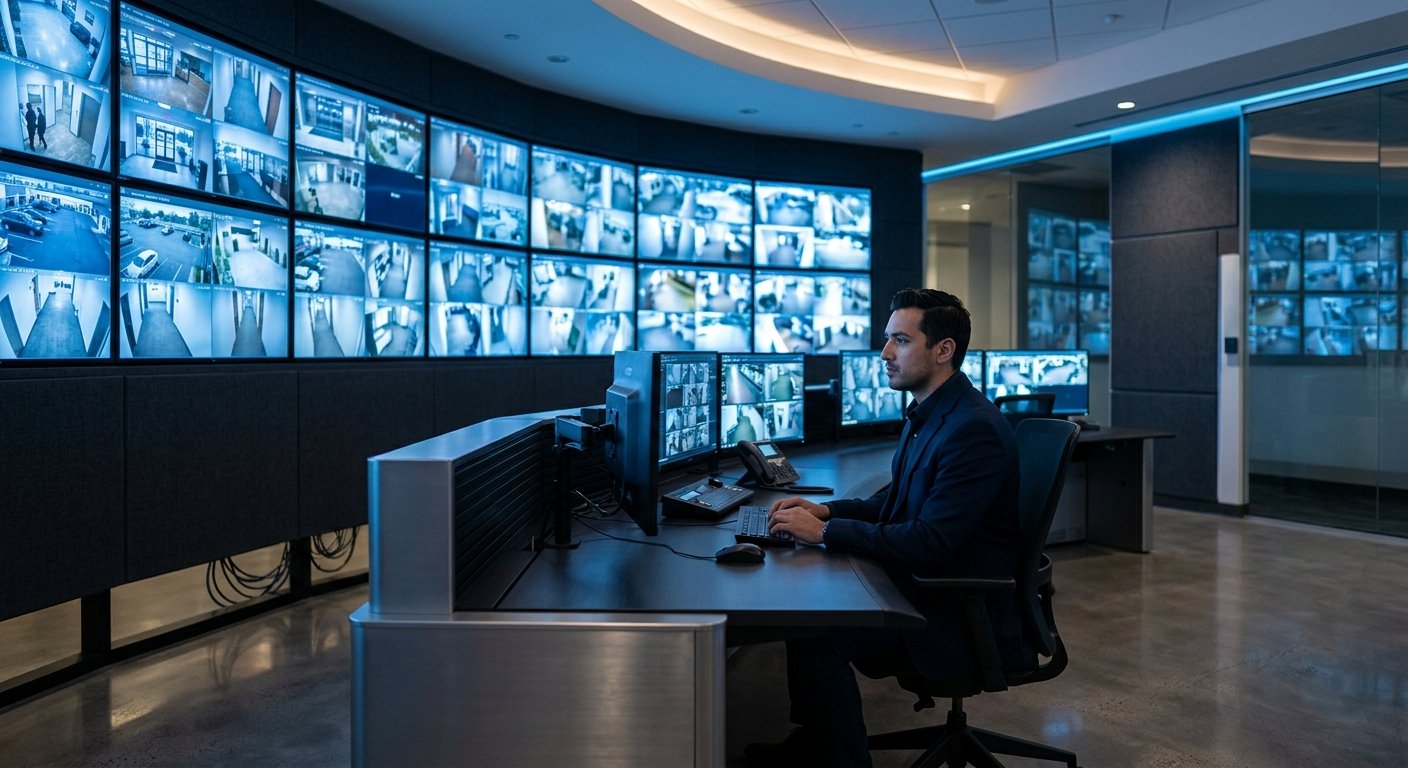
Live video surveillance means trained security professionals actively watch your camera feeds around the clock—not just record them. Unlike passive cameras that document crimes after the fact, real-time monitoring enables immediate intervention through audio warnings, live law enforcement contact, and instant client alerts, making it the proactive security standard for commercial properties, construction sites, auto dealerships, and residential communities.
- Passive recording documents crimes; live monitoring prevents them through real-time human intervention.
- Trained monitors issue audio warnings, contact law enforcement with live situational updates, and notify property owners the moment a threat is detected.
- A full-time on-site guard costs $50,000–$80,000 per year; remote monitoring delivers broader, 24/7 coverage at a fraction of that cost.
- Human judgment catches behavioral cues—like someone casing a property—that automated systems routinely miss.
- Construction sites, auto dealerships, retail centers, warehouses, and gated communities are among the strongest candidates for live monitoring.
A retail manager reviews footage the morning after a break-in and watches helplessly as the entire incident plays out on screen—the shattered window, the stolen merchandise, the clean getaway. The cameras worked perfectly. They captured everything. And they did absolutely nothing to stop it.
This is the fundamental problem with passive surveillance: recording a crime is not the same as preventing one. Live video surveillance changes that equation entirely. When trained security professionals are actively watching your property in real time, they can intervene before a break-in becomes a burglary, before a trespasser becomes a vandal, and before a liability risk becomes a lawsuit.
The Core Difference: Passive Recording vs. Active Monitoring
Traditional security cameras operate on a simple principle: record everything, review it later. That model made sense when storage and transmission technology limited what was possible. In 2026, it’s an outdated approach that leaves property owners exposed.
Live video surveillance—also called virtual security monitoring or remote video monitoring—means human eyes are actively watching your cameras in real time, around the clock. Not an algorithm. Not a motion-triggered notification. A trained security professional reviewing live feeds and ready to act the moment something looks wrong.
| What to compare | Passive Recording | Live Video Surveillance |
|---|---|---|
| Primary function | Documents incidents after the fact | Prevents incidents in real time |
| Human oversight | Reviewed after a crime occurs | Trained professionals watching 24/7 |
| Intervention capability | None during the incident | Audio warnings, law enforcement contact, client alerts |
| Law enforcement value | Historical footage only | Live situational updates to responders |
| Coverage area | Limited by on-site staff | Multiple zones simultaneously |
According to the Bureau of Justice Statistics, the majority of property crimes are opportunistic—criminals look for easy targets with low perceived risk of intervention. The presence of active monitoring, combined with visible deterrents like warning signage and real-time speaker challenges, dramatically changes that risk calculation for would-be offenders.
How Real-Time Remote Monitoring Actually Works
Understanding the mechanics helps property owners make smarter security decisions. Here’s the step-by-step process behind professional live video surveillance:
Camera Installation and Integration
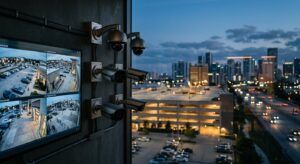
High-definition cameras are positioned strategically across your property—covering entry and exit points, perimeter fencing, parking areas, inventory zones, and any high-risk locations. These cameras transmit live feeds securely over the internet to a remote monitoring center.
24/7 Monitoring by Trained Professionals
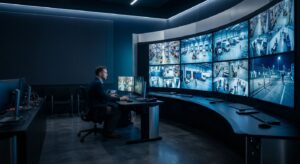
At Digital Security Guard’s monitoring center, trained security professionals watch multiple camera feeds simultaneously, 24 hours a day, 7 days a week. They’re not waiting for an alarm to trigger—they’re proactively scanning for suspicious behavior, unauthorized access, safety violations, and emerging threats.
Real-Time Intervention
When a monitoring professional spots a problem, they have several immediate response tools: two-way audio warnings that address trespassers directly, coordinated law enforcement contact with live video information, and instant client notification to keep property owners informed without requiring constant personal vigilance.
Documentation and Reporting
Every incident is logged, timestamped, and documented—creating an accurate, verifiable record that supports insurance claims, legal proceedings, and ongoing security assessments. This also helps identify patterns: recurring trespass attempts, high-risk time windows, or vulnerable access points that need additional attention.
Why the Human Element Matters
Artificial intelligence and automated detection have their place in a layered security system, but they cannot replace trained human judgment. Security professionals bring contextual awareness that algorithms simply lack.
An automated system might flag a maintenance worker making early morning rounds as a threat, or miss the subtle behavioral cues of someone casing a property before an attempted break-in. A trained monitor understands the difference. They know what normal looks like for your specific property, and they recognize when something is off—even before an overt threat materializes.
Cameras become tools of prevention rather than documentation—security professionals become an extension of your operations team.
The ASIS International security standards organization emphasizes the importance of human oversight in security operations, noting that effective threat detection requires both technological capability and professional judgment working together. That philosophy is at the heart of how Digital Security Guard’s 24/7 live monitoring services operate.
Real-World Applications Across Property Types
Live video surveillance isn’t a one-size-fits-all solution—it’s adapted to the specific risks and operational realities of each property type.
Construction Sites
Equipment theft costs the construction industry billions annually, and active job sites are high-value, often poorly secured targets. Real-time monitoring covers perimeter fencing, equipment yards, and material storage areas after hours, deterring theft and vandalism during the hours when sites are most vulnerable.
Retail Stores and Shopping Centers
Virtual security monitoring addresses both external threats like after-hours break-ins and internal concerns like employee theft and customer safety incidents. Monitors can observe multiple zones simultaneously—something no single on-site guard can replicate.
Auto Dealerships
A dealership lot represents millions of dollars in inventory sitting in an open, accessible space overnight. Live surveillance covers the entire lot perimeter, reacting instantly to trespass attempts and providing law enforcement with real-time vehicle and suspect descriptions.
Apartment Complexes and Gated Communities
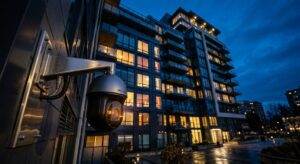
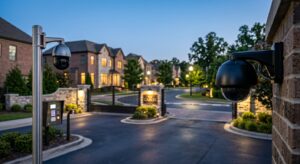
Residential communities require a balance of security and resident privacy. Remote monitoring focuses on common areas, parking structures, entry gates, and amenity spaces—providing meaningful protection without intrusive oversight of private living spaces. For communities that already have gate systems in place, gated community video monitoring integrates seamlessly with existing infrastructure.
Warehouses and Industrial Facilities
Large square footage and valuable inventory make warehouses difficult to secure with conventional methods. Live monitoring provides comprehensive coverage without the staffing costs of multiple on-site guards across different zones and shifts.
The Cost Advantage Over On-Site Security Guards
A full-time, on-site security guard costs a business between $50,000 and $80,000 per year when salary, benefits, training, and management overhead are factored in. And one guard can only physically be in one location at a time.
Remote video monitoring delivers broader coverage—multiple camera views, multiple zones, 24/7 professional attention—at a fraction of that cost. For multi-location businesses or large properties, the savings scale dramatically. Many property owners find that the ROI calculation becomes straightforward when they weigh monitoring costs against even a single prevented theft, vandalism incident, or liability claim.
This cost structure makes professional live surveillance accessible to mid-size operations that couldn’t justify the expense of a dedicated security team—leveling the playing field and giving smaller businesses and residential communities access to the same quality of proactive protection previously reserved for large corporate facilities.
Learn more about how commercial remote video monitoring compares to traditional security approaches for your specific property type.
Frequently Asked Questions
What is live video surveillance and how does it differ from standard security cameras?
Live video surveillance means trained security professionals are actively watching your camera feeds in real time, rather than simply recording footage for later review. Standard security cameras are passive—they document incidents but don’t prevent them. Live surveillance enables real-time intervention through audio warnings, law enforcement contact, and immediate client notification when a threat is detected.
How do remote monitoring professionals know when something is wrong?
Trained monitors proactively scan live feeds for suspicious behavior rather than waiting for automated triggers. They learn the normal patterns of each property they monitor and recognize anomalies—unusual movement, unauthorized access attempts, or behavioral cues—often before a crime escalates. Technology assists with alerts, but professional judgment drives the response.
Is live remote monitoring effective as a crime deterrent?
Yes. Visible surveillance infrastructure combined with real-time audio challenges—where a monitor directly addresses a trespasser through on-site speakers—creates a high perceived risk of intervention. Opportunistic criminals typically move on when they believe they are actively being watched and that authorities are being contacted in real time.
What types of properties benefit most from 24/7 video monitoring services?
Any property with significant assets, high-traffic access points, after-hours vulnerability, or large square footage benefits from live monitoring. Construction sites, auto dealerships, retail centers, warehouses, apartment complexes, and gated communities are among the most common applications. Essentially, any location where passive recording leaves gaps that a single on-site guard cannot cover is a strong candidate for remote monitoring.
How does remote video monitoring handle incidents when they occur?
When a monitoring professional identifies a threat, they follow a structured response protocol: issue an audio warning through on-site speakers, contact local law enforcement with a live situational update, and notify the property owner or designated contact immediately. The entire incident is documented with timestamped video for follow-up purposes.
Making the Shift to Proactive Security
The goal of any effective security strategy isn’t to create better evidence after a crime—it’s to prevent the crime from happening at all. That’s the core value proposition of live video surveillance: intervention in the moment, not investigation after the fact.
For property owners who have relied on passive recording systems, the transition to active monitoring represents a genuine shift in how security works. Cameras become tools of prevention rather than documentation. Security professionals become an extension of your operations team, watching over your property with the same attention and investment you would.
Digital Security Guard’s nationwide remote video monitoring services are designed to provide exactly this kind of proactive protection—combining advanced camera technology with trained human oversight to keep your property, your people, and your assets safer every hour of every day.
Get a Customized Live Surveillance Solution
Contact Digital Security Guard to discuss a monitoring plan tailored to your specific property type, risk profile, and budget—and stop relying on passive recording to protect what matters.

About Digital Security Guard
Digital Security Guard provides remote video monitoring solutions for commercial and residential property owners seeking proactive crime prevention rather than reactive recording. Combining advanced security technology with trained human monitoring professionals, they deliver 24/7 surveillance services that prevent theft, vandalism, and liability issues at a fraction of the cost of on-site security guards. Their solutions serve diverse property types including construction sites, retail stores, auto dealerships, apartment complexes, and gated communities across the nation. Visit digitalsecurityguard.com →