HOA boards face a sobering reality: a single slip-and-fall incident near an unsecured entrance, one vandalism lawsuit, or a package theft dispute can cost a community association tens of thousands of dollars in legal fees and settlements. According to the Community Associations Institute, there are over 370,000 homeowner associations in the United States, collectively managing communities where liability exposure grows more complex every year. In 2026, HOAs that haven’t modernized their security approach are leaving themselves dangerously exposed.
The good news? HOA security monitoring has evolved dramatically. Modern residential video monitoring doesn’t just record incidents after the fact—it actively deters crime, documents liability events in real time, and provides the kind of evidence that protects communities in legal disputes. Here’s what HOA boards and property managers need to understand about reducing liability through proactive surveillance.
Why Liability Is the Defining Security Issue for HOAs in 2026
Most HOA boards think about security in terms of theft and vandalism. Those are legitimate concerns, but liability is increasingly the larger financial threat. When a resident is assaulted in a poorly lit parking area, when a guest is injured near an unsecured gate, or when a contractor is accused of damaging property without video proof to clarify what happened—the HOA often ends up in the crosshairs.
Courts have consistently held that property managers and community associations have a duty of care to residents and visitors. Failing to maintain adequate security measures—including functional surveillance—can be treated as negligence. The Insurance Information Institute notes that premises liability claims are among the most common and costly lawsuits facing property owners and managers.
This is precisely why neighborhood security monitoring is no longer optional for communities that take risk management seriously. It’s a foundational part of responsible HOA governance.
The Problem with Passive Security Systems
Many HOAs already have cameras installed. The critical question is: what’s actually happening with that footage?
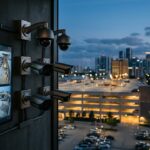
If the answer is “we review it after something goes wrong,” your community has a recording system—not a security system. There’s a fundamental difference. Passive cameras document events. Active, monitored surveillance prevents them.
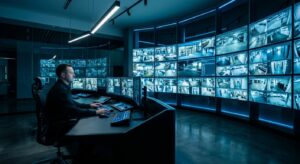
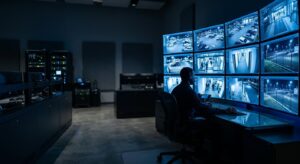
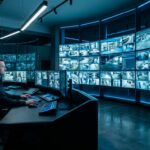
Consider a realistic scenario: it’s 2 a.m. on a Tuesday and someone is tampering with vehicles in the guest parking lot. A passive camera records the incident. By morning, three cars have broken windows, residents are furious, and the HOA faces questions about why no one was watching. Now compare that to a system backed by 24/7 video monitoring services with trained professionals actively watching the feeds. When the suspicious activity begins, a live monitoring professional sees it, issues a verbal warning through on-site speakers, and contacts local authorities with a real-time description. The incident stops before damage occurs.
That’s the difference between reactive recording and proactive crime prevention.
Key Areas Where HOA Security Monitoring Reduces Liability
Access Control Points
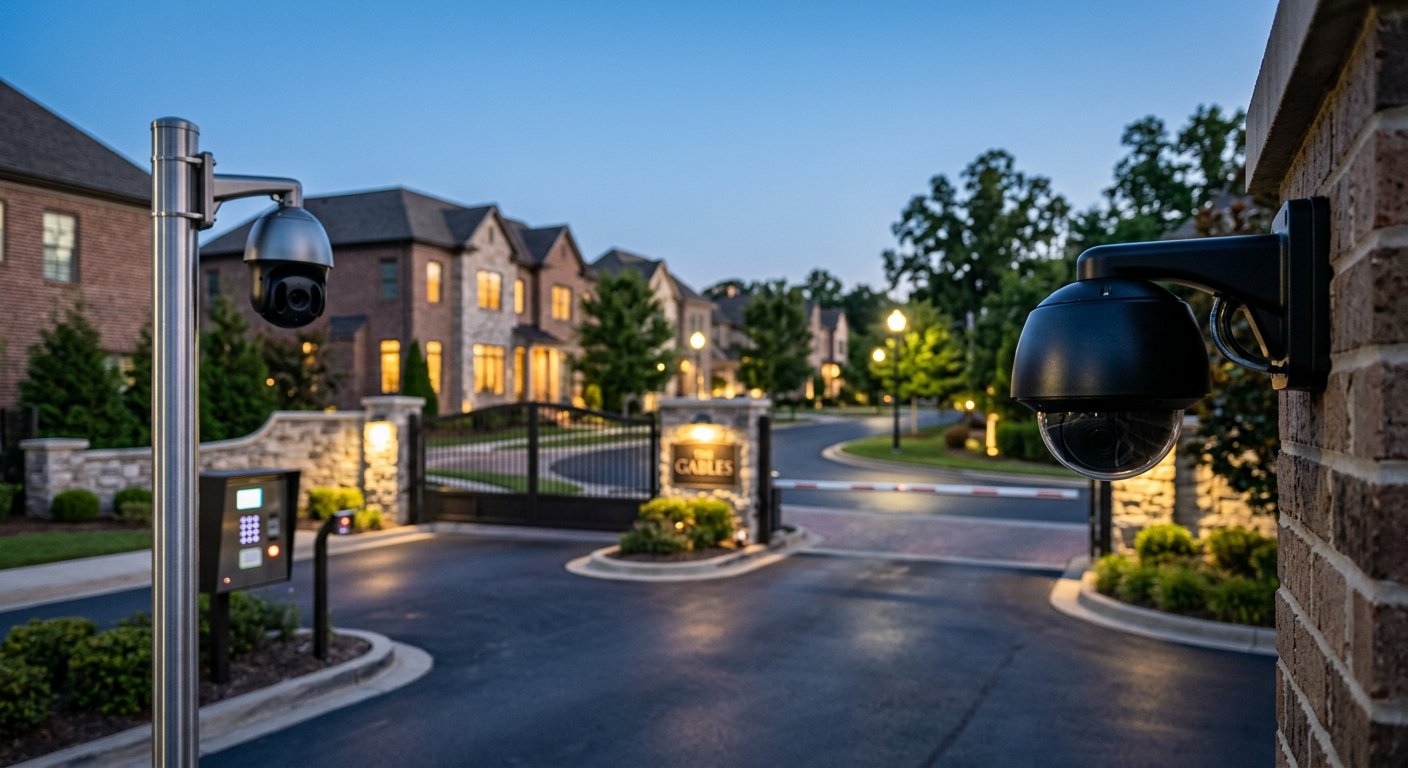
Gated entrances and community access control monitoring are among the most liability-sensitive areas in any residential community. Unauthorized vehicle entry, tailgating through gates, and confrontations at access points are documented risk zones. Remote monitoring professionals can observe entry and exit activity in real time, flag anomalies, and ensure access logs are accurate—providing a clear audit trail if disputes arise.
For communities interested in a deeper look at access monitoring capabilities, our gated community video monitoring solutions are built specifically for this challenge.
Common Areas and Amenity Spaces
Pools, fitness centers, clubhouses, and parking structures are high-traffic, high-liability environments. Monitoring these spaces around the clock means that policy violations, unsafe behavior, and genuine emergencies are identified quickly. Video evidence from monitored cameras has been instrumental in resolving disputes between residents, defending against fraudulent injury claims, and documenting incidents accurately.
Perimeter and Parking Areas
Vehicle damage, package theft, and after-hours trespassing concentrate heavily in parking areas. Consistent residential community surveillance of these zones significantly reduces both incident frequency and the HOA’s exposure when incidents do occur. When every area is monitored and documented by professionals—not just recorded passively—the community demonstrates a meaningful standard of care.
Remote Video Monitoring vs. On-Site Guards: An Honest Comparison
Some HOA boards assume that hiring on-site security officers is the gold standard. The reality is more nuanced—and the cost differential is striking.
A single on-site security guard working 24/7 coverage requires multiple personnel across shifts, accounting for weekends, holidays, and sick days. Annual costs for round-the-clock guard coverage at a single property routinely exceed $150,000. Remote video monitoring services deliver continuous, professional surveillance at a fraction of that cost—typically 50 to 80 percent less—while providing broader camera coverage than any individual guard walking a route can achieve.
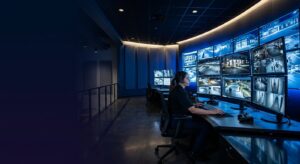
Remote monitoring professionals also never get distracted, fatigued, or engaged in conversation when they should be watching feeds. Trained specialists can monitor multiple camera angles simultaneously, respond to developing situations faster, and document everything with digital precision. For HOA boards managing tight budgets while facing growing liability exposure, this cost-to-protection ratio is difficult to argue against.
What Professional HOA Security Monitoring Actually Looks Like
Effective residential video monitoring for an HOA isn’t just cameras pointed at gates. It’s a coordinated system that includes:
- Strategically placed cameras covering access points, common areas, parking facilities, and perimeter zones
- 24/7 live monitoring by trained security professionals who understand community security protocols
- Real-time intervention through on-site audio warnings when suspicious activity is detected
- Documented incident reports that provide evidence for law enforcement, insurance claims, and legal proceedings
- Rapid notification procedures that alert HOA management and appropriate authorities when incidents occur
Digital Security Guard’s nationwide remote video monitoring services are designed to integrate seamlessly with existing community infrastructure, providing professional oversight without the overhead of physical guard deployment. Our trained monitoring professionals understand that each community has unique needs—and that preventing a problem is always preferable to documenting one.
Building a Defensible Standard of Care
From a legal standpoint, one of the most valuable aspects of professional HOA security monitoring is its role in establishing a defensible standard of care. When an HOA can demonstrate that it invested in professional, continuous surveillance—not just passive cameras—and that trained professionals were actively monitoring the property, the legal argument for negligence becomes considerably harder to sustain.
The National Fire Protection Association and similar bodies have long emphasized that documented safety systems and response protocols are central to liability defense in property management contexts. The same logic applies directly to security monitoring: systems that demonstrate active oversight carry significantly more legal weight than recording-only setups.
This is why documentation matters as much as prevention. Professional monitoring generates timestamped records, incident reports, and chain-of-custody documentation for video evidence—all of which are invaluable if your community ever faces a claim or lawsuit.
Practical Steps for HOA Boards Evaluating Security Monitoring
If your community is ready to modernize its approach, here’s a practical framework for getting started:
- Audit your current vulnerabilities. Walk the property and identify camera blind spots, unmonitored access points, and areas with a history of incidents or complaints.
- Review your incident and claim history. Past incidents reveal patterns. Where have liability events concentrated? That’s where monitoring resources should prioritize.
- Evaluate monitoring options honestly. Compare the true cost of on-site guards with 24/7 professional remote monitoring, factoring in coverage breadth and documentation quality.
- Establish clear protocols. Effective community surveillance requires defined escalation procedures—who gets notified, when, and how.
- Communicate with residents. Transparency about security investments builds community trust and reinforces the HOA’s commitment to resident safety.
Frequently Asked Questions
What is HOA security monitoring and how does it differ from standard security cameras?
HOA security monitoring refers to professionally managed, 24/7 surveillance of a residential community using cameras watched in real time by trained security professionals. Unlike standard security cameras that only record, active monitoring allows immediate intervention—verbal warnings, authority notifications, and documented responses—when incidents occur.
How does remote video monitoring help reduce HOA liability?
Remote monitoring creates a documented record of community surveillance, demonstrates an active standard of care, provides real-time evidence of incidents, and enables faster response to emerging situations. This combination makes it significantly harder to sustain negligence claims against an HOA and provides strong evidentiary support when disputes arise.
Is gated community video monitoring worth the investment for smaller HOAs?
Yes. Remote monitoring is scalable and considerably more cost-effective than on-site security. Even smaller communities benefit from professional monitoring at access points and common areas, where liability exposure is highest relative to community size.
Can remote monitoring cover the entire community, or just entry points?
Professional residential community surveillance systems can cover access points, parking areas, common amenities, perimeter zones, and any other areas the HOA identifies as priorities. Coverage is customized to the community’s specific layout and risk profile.
How quickly do monitoring professionals respond when something is detected?
Trained monitoring professionals observe camera feeds continuously and can respond to developing situations in real time—issuing on-site audio warnings and contacting appropriate authorities as events unfold, rather than hours later during a post-incident review.
Protect Your Community. Reduce Your Exposure.
Liability doesn’t wait for convenient hours, and neither should your security. HOA boards that invest in professional, proactive monitoring in 2026 are making a decision that protects residents, preserves property values, and builds a defensible record against future claims.
Digital Security Guard provides 24/7 live monitoring by trained security professionals, delivering nationwide remote video monitoring services tailored to residential communities of all sizes. If your HOA is ready to move beyond passive recording and toward genuine crime prevention and liability protection, contact our team today for a customized community security assessment.