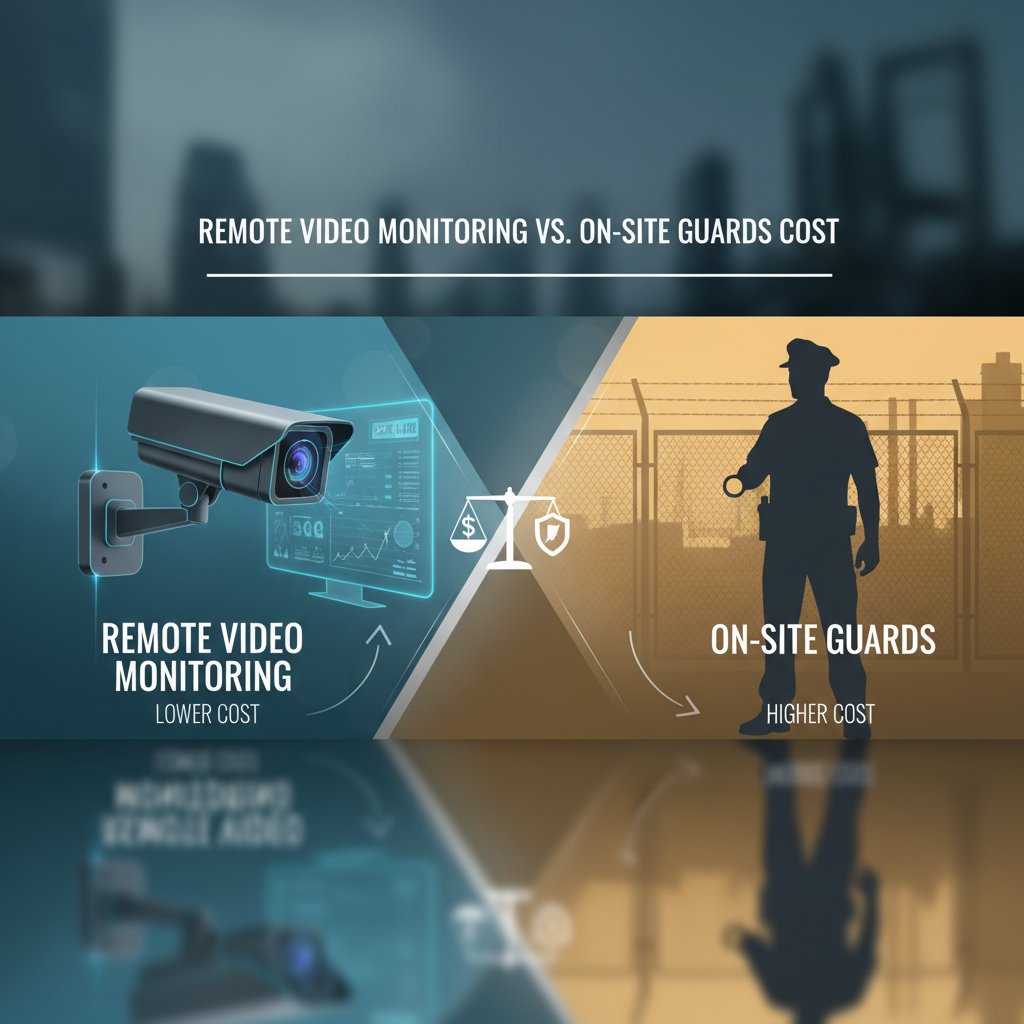
Security budgets are under constant pressure. A single on-site security guard can cost businesses between $60,000 and $100,000 annually when factoring in wages, benefits, insurance, and management overhead. For properties requiring 24/7 coverage with multiple guards, that figure quickly climbs into the hundreds of thousands. As commercial property managers and business owners search for cost-effective security solutions in 2026, commercial remote video monitoring has emerged as a practical alternative that delivers superior coverage at a fraction of the cost.
The True Cost of On-Site Security Guards
When evaluating security expenses, many decision-makers initially consider only the hourly wage. However, the actual investment in on-site guards extends far beyond base pay.
Direct Costs of Physical Security Guards
A security guard earning $18-25 per hour represents just the starting point. For comprehensive 24/7 coverage requiring multiple shifts, businesses must account for:
- Base wages: $60,000-$85,000 per guard annually
- Payroll taxes and workers’ compensation insurance: 15-25% additional
- Healthcare benefits and paid time off: $8,000-$15,000 per employee
- Training and certification requirements: $1,500-$3,000 per guard
- Uniform and equipment costs: $500-$1,200 annually
- Supervisory and administrative overhead: 10-15% of total labor costs
A single guard position covering all shifts throughout the year typically requires hiring 4-5 individuals to account for days off, vacation time, sick leave, and turnover. This means a business seeking continuous coverage at one entrance point actually needs to budget $250,000-$400,000 annually.
Hidden Costs of Traditional Security Personnel
Beyond direct compensation, on-site guards introduce operational challenges that impact the bottom line. Employee turnover in the security industry averages 100-300% annually, creating constant recruitment and training expenses. Each vacant shift requires expensive emergency coverage or leaves properties vulnerable.
Liability concerns represent another hidden expense. Guards can face confrontational situations that escalate to physical altercations, creating potential lawsuits and workers’ compensation claims. These incidents increase insurance premiums and expose businesses to significant legal costs.
Human limitations also affect coverage quality. Even the most diligent guard cannot simultaneously monitor multiple areas, maintain perfect attention during overnight hours, or provide documented evidence of their entire patrol route without gaps.
Commercial Remote Video Monitoring: A Cost-Effective Alternative
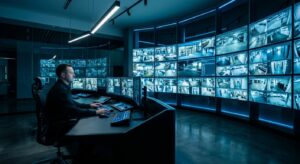
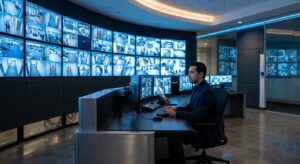
Business video monitoring services provide professional security surveillance through strategically placed cameras connected to remote monitoring stations staffed by trained security professionals. Unlike passive recording systems, commercial surveillance monitoring delivers active threat detection and immediate response.
How Remote Monitoring Systems Work
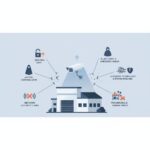
Modern commercial property monitoring integrates high-definition cameras with intelligent analytics software. Motion detection, perimeter breaches, and unusual activity trigger alerts to remote monitoring centers where security professionals assess the situation in real-time.
When suspicious activity is detected, monitoring personnel can issue verbal warnings through two-way speakers, activate lights and alarms, and contact law enforcement with specific descriptions of ongoing crimes. This proactive intervention prevents theft, vandalism, and unauthorized access rather than simply recording incidents for later review.
The technology has advanced significantly. Today’s business security monitoring systems feature night vision capabilities, license plate recognition, facial detection, and integration with access control systems. Cloud-based platforms allow property owners to view live feeds from anywhere while maintaining archived footage for investigations and liability protection.
Breaking Down Remote Monitoring Costs
Commercial remote video monitoring typically costs between $300-$1,200 per month per property, depending on several factors.
Initial Installation Investment
Equipment and installation costs vary based on property size and coverage requirements. A typical commercial installation ranges from $3,000-$15,000, including:
- High-definition cameras with night vision: $300-$1,500 per camera
- Network video recorders or cloud storage infrastructure: $500-$2,000
- Professional installation and system configuration: $1,500-$5,000
- Integration with existing security systems: $500-$3,000
While this represents a significant upfront investment, it’s typically recovered within 3-6 months when compared to guard services.
Ongoing Monthly Monitoring Fees
Business video monitoring services charge monthly fees based on the number of cameras monitored, monitoring hours required, and response protocols. Standard pricing structures include:
- Basic monitoring (4-8 cameras, after-hours coverage): $300-$600 monthly
- Standard monitoring (8-16 cameras, 24/7 coverage): $600-$900 monthly
- Comprehensive monitoring (16+ cameras, multiple locations): $900-$1,500 monthly
These fees cover professional monitoring personnel, system maintenance, software updates, cloud storage, and technical support. Unlike guard services, there are no payroll taxes, benefits, or turnover costs to manage.
Direct Cost Comparison Analysis
The financial advantage of commercial surveillance monitoring becomes clear through direct comparison. Consider a retail store requiring overnight security coverage from 6 PM to 6 AM, seven days per week.
On-Site Guard Costs (Annual)
Two full-time equivalent guards for 12-hour shifts cost approximately:
- Combined wages and benefits: $140,000-$180,000
- Payroll taxes and insurance: $25,000-$35,000
- Management and administrative overhead: $15,000-$20,000
- Total annual cost: $180,000-$235,000
Remote Monitoring Costs (Annual)
Comparable coverage through business security monitoring includes:
- Initial system installation: $8,000 (one-time)
- Monthly monitoring fees: $700 × 12 = $8,400
- First-year total: $16,400
- Subsequent years: $8,400 annually
The savings are substantial—approximately $164,000 in the first year and $172,000 annually thereafter. Over a five-year period, commercial remote video monitoring saves roughly $700,000 compared to traditional guard services for this single location.
Enhanced Coverage and Capabilities
Beyond cost savings, commercial property monitoring delivers security advantages that physical guards cannot match.
Comprehensive Property Coverage
A single guard can only be in one location at a time, creating blind spots and predictable patrol patterns that sophisticated criminals exploit. Remote monitoring systems provide simultaneous coverage of all critical areas—entrances, parking lots, loading docks, perimeters, and high-value storage locations.
For properties like auto dealerships with valuable inventory spread across multiple acres, or construction sites with equipment scattered across different zones, this comprehensive visibility is impossible to achieve with traditional guards.
Documented Evidence and Liability Protection
Video documentation provides irrefutable evidence for insurance claims, criminal prosecutions, and liability disputes. Recorded footage proves what occurred during incidents, protecting businesses from fraudulent injury claims and providing law enforcement with actionable evidence.
This documentation capability also extends to operational oversight. Property managers can verify contractor arrival times, monitor loading dock activities, and review employee adherence to security protocols without being physically present.
Consistency and Reliability
Business video monitoring services eliminate human variability. Guards experience fatigue, distraction, and the physical impossibility of maintaining constant vigilance throughout overnight shifts. Technology doesn’t lose focus, take unauthorized breaks, or fail to show up for scheduled shifts.
The system operates identically at 3 AM as it does at 3 PM, providing consistent protection regardless of conditions or circumstances.
Industry-Specific Applications
Different commercial sectors benefit from remote monitoring in distinct ways.
Construction Sites
Construction theft costs the industry over $1 billion annually. Equipment, materials, and copper wiring are frequent targets. Commercial surveillance monitoring protects these vulnerable sites where on-site guards are impractical due to lack of facilities and changing site configurations. Remote monitoring adapts as construction progresses, with cameras repositioned to cover new areas and valuable materials.
Retail Locations
Retail businesses face both external threats and internal theft concerns. Business security monitoring provides after-hours protection while also documenting employee activities, cash handling procedures, and customer incidents. The presence of monitored cameras reduces shrinkage from employee theft, which accounts for approximately 38% of retail inventory loss.
Apartment Communities
Residential property managers must balance security with budget constraints and resident expectations. Commercial property monitoring protects common areas, parking structures, and entry points without the invasive presence of roaming guards. Many residents actually prefer monitored cameras to physical security personnel in amenity areas and hallways.
Auto Dealerships
Vehicle inventory represents millions in assets sitting in open lots. Remote monitoring protects this investment while documenting test drives, after-hours activity, and lot organization. License plate recognition technology tracks every vehicle entering and exiting the property, creating an additional security layer impossible with traditional guards.
Return on Investment Calculation
When evaluating security investments, property owners should consider both cost avoidance and loss prevention.
A single significant theft incident—$50,000 in stolen construction equipment, $30,000 in merchandise, or $100,000 in vehicle inventory—can exceed multiple years of monitoring fees. Commercial remote video monitoring prevents these losses through proactive intervention and deterrence.
Insurance companies increasingly recognize this value. Many insurers offer premium reductions of 5-20% for properties with professionally monitored security systems, creating additional annual savings that improve overall ROI.
Making the Transition
Switching from guard services to business video monitoring services requires strategic planning. Begin with a professional security assessment identifying vulnerable areas, optimal camera placement, and monitoring requirements specific to your property and industry.
Many businesses implement hybrid approaches during transition periods, combining reduced guard presence with expanding remote monitoring coverage. This phased implementation allows evaluation of system performance while maintaining security continuity.
Select monitoring partners who understand your industry’s specific challenges and can provide references from similar properties. Professional monitoring centers should be U.S.-based, staffed with trained security personnel, and equipped with clear escalation protocols for different threat scenarios.
Protect Your Property With Professional Monitoring
The financial case for commercial remote video monitoring is compelling, but the decision ultimately centers on effective security protection. Modern business security monitoring delivers superior coverage, consistent performance, and documented accountability at a fraction of traditional guard costs.
Digital Security Guard specializes in commercial surveillance monitoring solutions tailored to your property’s unique requirements. Our trained security professionals provide 24/7 monitoring with immediate response protocols, transforming cameras from passive recording devices into active crime prevention tools. Contact us today to receive a customized security assessment and discover how remote monitoring can protect your property while dramatically reducing security expenses.